Forging a New Dawn - Revitalization of Darukhana


Project idea
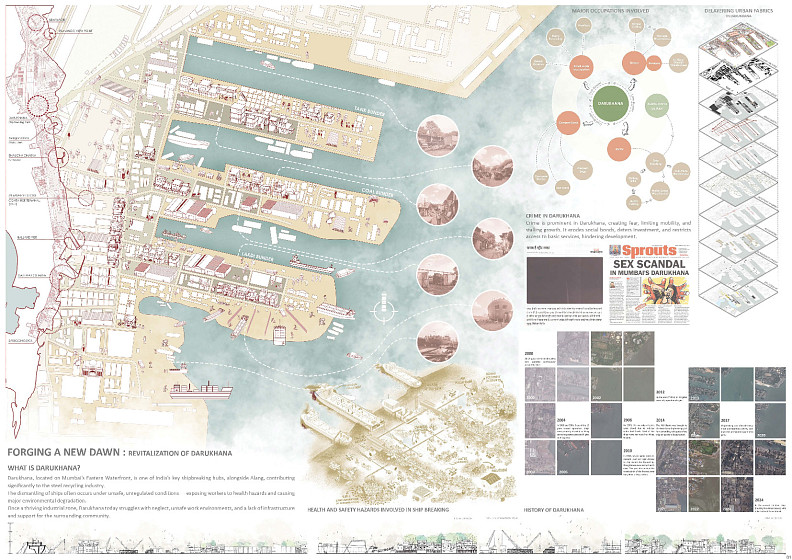
The project, titled "Forging a New Dawn," is a socio-ecological intervention situated in the Darukhana shipbreaking yards of Mumbai. Historically an industrial backbone, Darukhana currently exists as a "shadow space"—a site of extreme environmental toxicity, hazardous labor, and social exclusion.
The core idea is to move beyond mere demolition and instead treat the site as a laboratory for the Circular Economy. The project aims to reconcile the harsh realities of industrial shipbreaking with the urgent need for urban ecological restoration and social equity. The primary goal is to transform a polluting, inward-looking industrial edge into a transparent, productive, and resilient waterfront that benefits the city's biodiversity and its most marginalized workers.
Objectives:
- Industrial Reform: To modernize shipbreaking through "Green Ship Recycling" technologies that prevent heavy metal contamination of the Arabian Sea.
- Social Empowerment: To provide the migrant workforce with institutional support through healthcare, skill-training, and civic spaces.
- Cultural Restoration: To create a maritime cultural anchor that preserves the "memory of the craft" while educating the public on sustainable industrial futures.
Project description
The project operates at two scales: a Master Plan for the Darukhana district and a Detailed Architectural Intervention focused on three key nodes.
The scope includes:
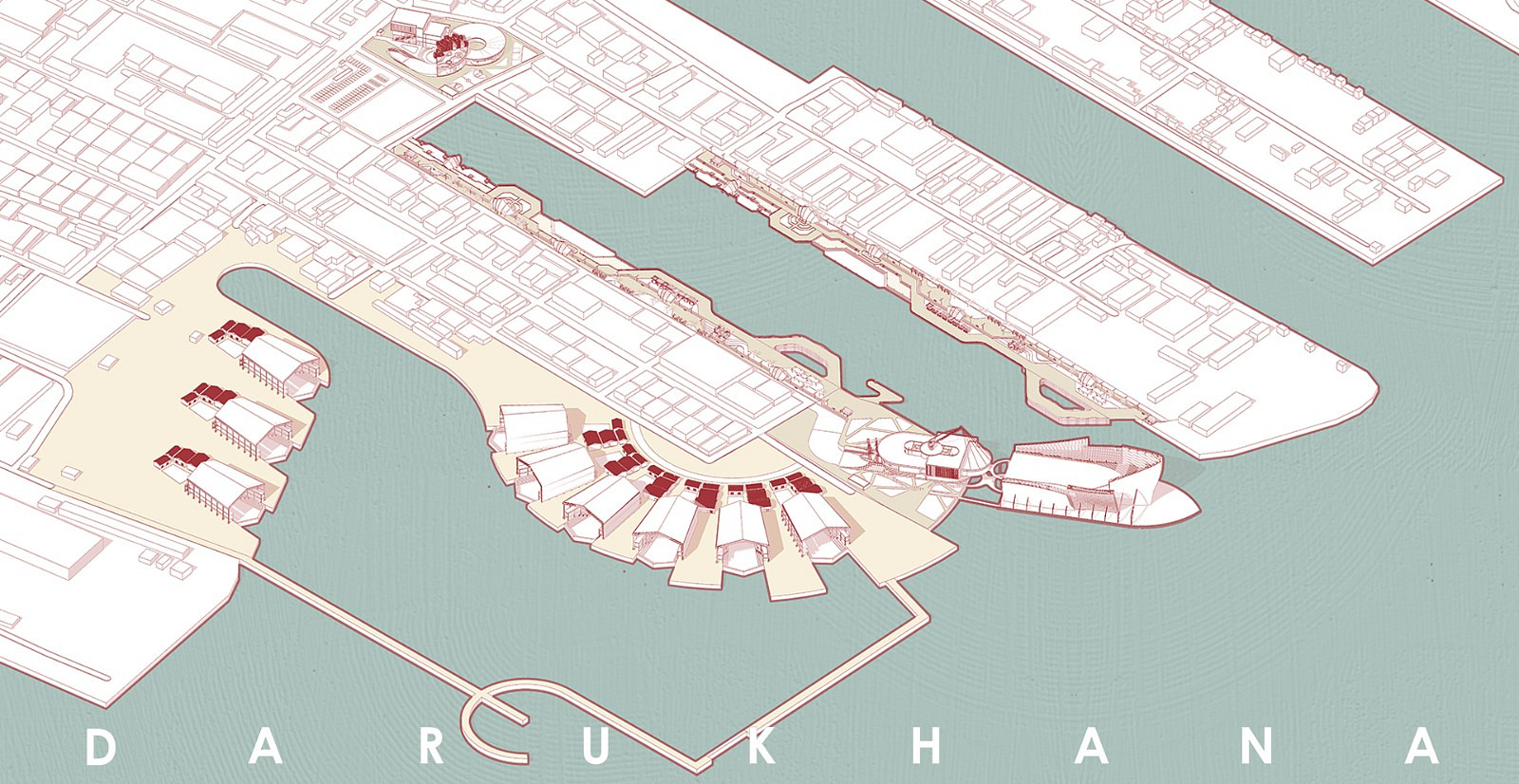
- The Re-imagined Industrial Edge: A series of upgraded dry docks designed with containment systems to manage hazardous waste. This area remains an active economic zone but is redesigned for safety and transparency.
- The Community and Training Center: A modular, circular building complex that acts as the social heart of the site. It houses vocational workshops, primary healthcare clinics, and a "Common Ground" for community assembly.
- The Shipyard Museum & Waterfront Promenade: A public-facing cultural landscape that bridges the city and the sea. The museum’s structure is inspired by the skeletal remains of ships, housing galleries that tell the story of Mumbai's maritime history.
- The Ecological Buffer: A landscape strategy that introduces bioswales and tidal-sensitive vegetation to naturally filter runoff before it enters the harbor.
Technical information
The project implements specialized technical solutions to address industrial safety and ecological resilience:
- Renewable Energy Systems: Integration of tidal energy generation along wet basin edges to harness coastal movement. The Community Center features solar panels designed to meet its annual energy demand sustainably, while piezoelectric tiles along the promenade convert foot traffic into decentralized power.
- Industrial Modernization: The shipbreaking yards are upgraded with covered dry docks and raised work platforms for safer dismantling. To protect marine biodiversity, the design incorporates enclosed basins and floating trash barriers to contain debris and prevent waste from entering the sea.
- Structural Innovation: The Museum utilizes a crane-inspired cantilever system supported by suspended cables that mimic industrial rigging to distribute loads efficiently. The entry canopy is constructed from repurposed actual hull segments mounted on a custom steel cradle.
- Adaptive Architecture: The Community Center employs sliding foldable shutters and modular containers to allow for multi-functional space division. Building facades are wrapped in vertical fins to provide dynamic shading and texture while managing heat gain.
Documentation


Copyright © 2025 INSPIRELI | All rights reserved. Use of this website signifies your agreement to the Terms of Use, Privacy Policy, and use of cookies.