衡境所The Place of Balance:Parametric Feng Shui


Project idea
Design Statement: The Place of Balance
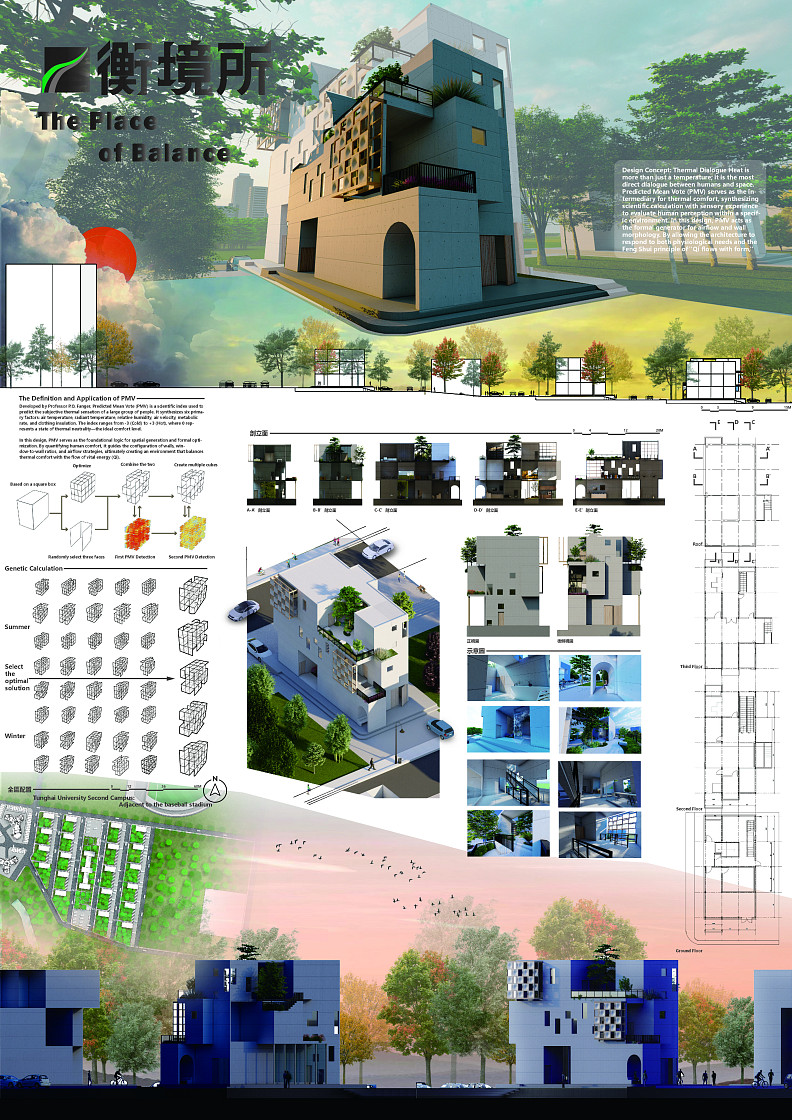
1. Design Vision: Quantifying the Invisible The project, titled "The Place of Balance," aims to bridge the gap between traditional Feng Shui wisdom and modern building science. Inspired by the Feng Shui principle that "Qi flows with form," the design conceptualizes "Thermal Dialogue" as the most direct interaction between humans and architectural space. The objective is to transform the abstract concept of "Qi" (energy flow) into quantifiable data, creating an environment that harmoniously balances scientific calculation with sensory experience.
2. Core Parameter: PMV as the Intermediary To operationalize these concepts, Predicted Mean Vote (PMV) is utilized as the primary control parameter. Unlike simple temperature readings, PMV acts as a comprehensive "intermediary for thermal comfort," synthesizing six key factors: air temperature, mean radiant temperature, relative humidity, air velocity, metabolic rate, and clothing insulation. This index helps define the ideal state of "thermal neutrality," guiding the design toward a comfort range between -3 (Cold) and +3 (Hot).
3. Technical Workflow: Parametric Evolution via Grasshopper The design form is generated and optimized using Rhino and Grasshopper, employing a Genetic Calculation workflow to determine the building's morphology. The process follows a strict logic:
• Initialization: The system begins with a base "square box" and randomly selects surfaces for potential modification.
• Simulation: The script runs "PMV Detection" iterations, analyzing how changes in form affect internal comfort.
• Optimization: Through genetic algorithms, the design is tested against both Summer and Winter conditions. The system automatically adjusts wall morphology, window-to-wall ratios, and airflow strategies to "select the optimal solution" that maintains comfort year-round.
4. Conclusion In this design, PMV serves as the "formal generator," dictating the physical configuration of the architecture. By allowing the building's form to evolve based on thermal data, "The Place of Balance" successfully translates the ancient pursuit of harmonious energy flow into a modern, data-driven reality.
Project description
1.The solution scope of "The Place of Balance" aims to bridge the gap between traditional Feng Shui and modern building science. The design focuses not only on aesthetics but also establishes PMV (Predicted Mean Vote) as the intermediary for thermal comfort, responding to both physiological needs and the Feng Shui principle that "Qi flows with form". The solution translates abstract "Qi" into quantifiable data to create a living environment that balances rational calculation with sensory experience.
2.The solution includes a complete design workflow based on Genetic Calculation. The scope starts from a basic "square box" geometry and proceeds through random face selection and iteration, utilizing Rhino and Grasshopper platforms. This process aims to screen for the "optimal solution" regarding window-to-wall ratios and airflow strategies for different seasonal conditions (Summer and Winter).
3. Physically, the solution is located at Tunghai University Second Campus, adjacent to the baseball stadium. The design scope covers spatial planning across four levels, from the Ground Floor to the Roof, achieving Thermal Neutrality within the indoor environment through specific wall morphologies and porosity.
Technical information
1. Project Identity & Site Specifications
• Project Name: The Place of Balance.
• Site Location: Tunghai University Second Campus.
• Specific Context: Adjacent to the baseball stadium.
• Design Philosophy: The project integrates the Feng Shui principle "Qi flows with form" with modern building physics, utilizing "Thermal Dialogue" as the primary interaction between humans and space.
2. Environmental Performance Metric: PMV System The technical core of the project relies on the Predicted Mean Vote (PMV) index.
• Origin: Developed by Professor P.O. Fanger.
• Definition: A scientific index used to predict the subjective thermal sensation of a large group of people.
• Input Variables: The system synthesizes six primary factors:
1. Air temperature
2. Radiant temperature
3. Relative humidity
4. Air velocity
5. Metabolic rate
6. Clothing insulation.
• Measurement Scale: The index ranges from -3 (Cold) to +3 (Hot).
• Technical Goal: To achieve a state of "thermal neutrality" (where PMV represents 0), defined as the ideal comfort level.
3. Computational Logic: Genetic Calculation Workflow The architectural form is generated through a rigorous parametric workflow titled "Genetic Calculation".
• Base Geometry: The process begins "Based on a square box".
• Mutation Logic: The algorithm acts to "Randomly select three faces" of the geometry for modification.
• Simulation Stages:
◦ Execution of "First PMV Detection" and "Second PMV Detection".
◦ The system works to "Combine the two" and "Create multiple cubes".
• Optimization:
◦ The workflow analyzes matrices for both Summer and Winter conditions.
◦ The algorithm functions to "Select the optimal solution", balancing window-to-wall ratios and airflow strategies to maintain the target PMV range.
4. Architectural & Spatial Specifications
• Vertical Program: The design is organized across four primary levels:
◦ Ground Floor
◦ Second Floor
◦ Third Floor
◦ Roof
• Sectional Design: The project includes detailed sections (A-A' through E-E' Section) which reveal internal spatial configurations designed to facilitate the flow of "vital energy (Qi)" and air.
• Morphology: PMV acts as the "formal generator," dictating the specific "configuration of walls" and "airflow strategies" rather than traditional aesthetic choices.
Documentation


Copyright © 2025 INSPIRELI | All rights reserved. Use of this website signifies your agreement to the Terms of Use, Privacy Policy, and use of cookies.